





.jpg)
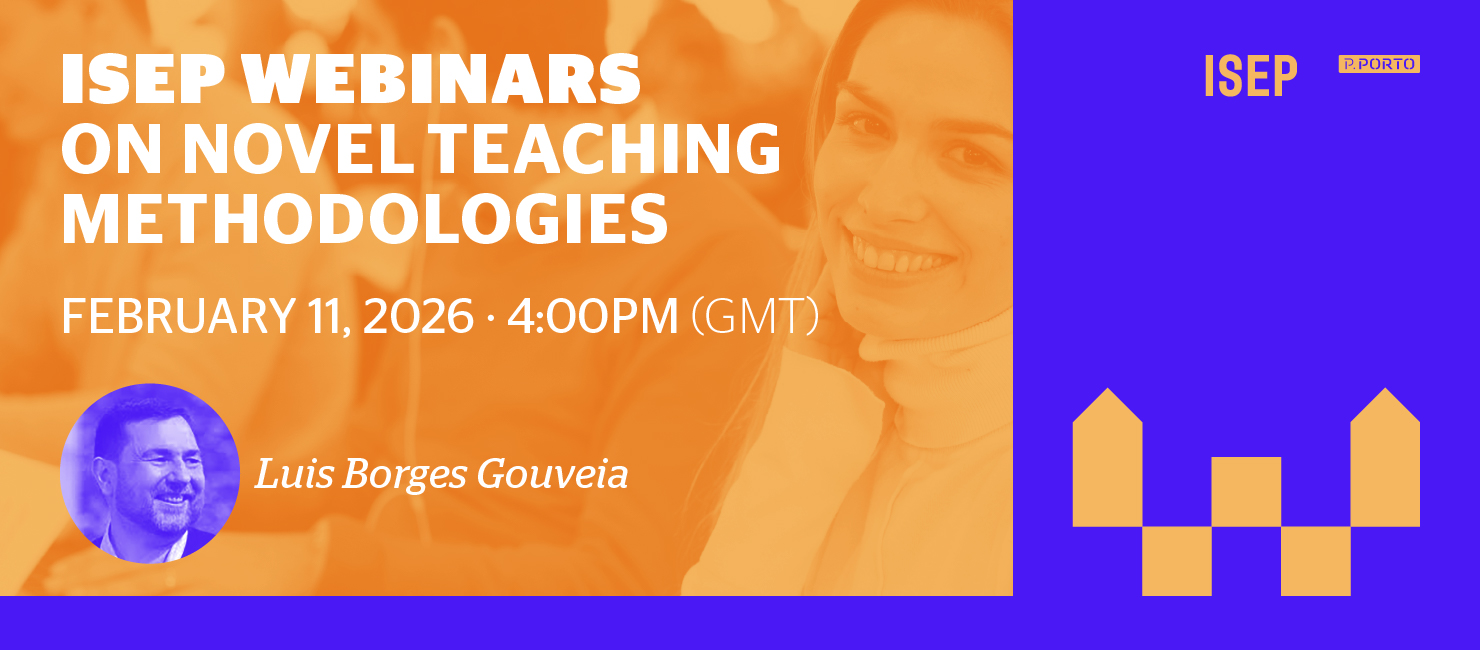
On February 11, at 4:00 p.m., there will be a session of ISEP Webinars, organized by Instituto Superior de Engenharia do Porto (ISEP).
This seminar, presented by Luís Borges Gouveia, has as its theme “Artificial Intelligence as unfinished work: a brief yet critical analysis”.
To access the webinar please click here.
Abstract
This presentation offers a critical analysis of the integration of Artificial Intelligence (AI) within the educational ecosystem, starting from the premise that true Artificial Intelligence does not yet exist. What we currently use are powerful statistical systems, although fluent and fast, they lack human understanding, causal reasoning, and the ability to verify truth. The discussion focuses on the intellectual danger of substituting verification with speed and reasoning with trust, which leads a society to stop questioning.
Instead of genuine education, we are witnessing the emergence of dependency training, where students are taught to use tools to generate ideas or summaries, rather than learning how to refute, reason, or ask why. The narrative that AI is a finished product is a curiosity-killer; in reality, we are only at the beginning of a process filled with unsolved problems regarding bias and explainability. Therefore, it is argued that every AI output should be treated as a hypothesis rather than a definitive answer, and every model as a study case instead of an oracle. The ultimate goal is to ensure that learners do not become passive users of alien intelligence, but remain curious minds engaged in the sovereign act of discovery.
Short Bio
Luís Borges Gouveia is a Full Professor at the University Fernando Pessoa (UFP) in Porto, Portugal, with over 30 years of experience in higher education. His work focuses on digital transformation, the information society, and how digital networks can improve human daily life. His academic background includes a Post-Doctorate in Information Science from the Faculty of Arts and Humanities, University of Porto; a Habilitation in Industrial Engineering and Management from the University of Aveiro; a PhD in Computer Science from Lancaster University, United Kingdom, and an MSc in Electronic and Computer Engineering from the Faculty of Engineering, University of Porto (FEUP). Throughout his career, Professor Gouveia has published more than 40 books (edited and translated into seven languages) and over 200 scientific papers. His research interests include cybersecurity, smart cities, and the human dimension of artificial intelligence.