





.jpg)
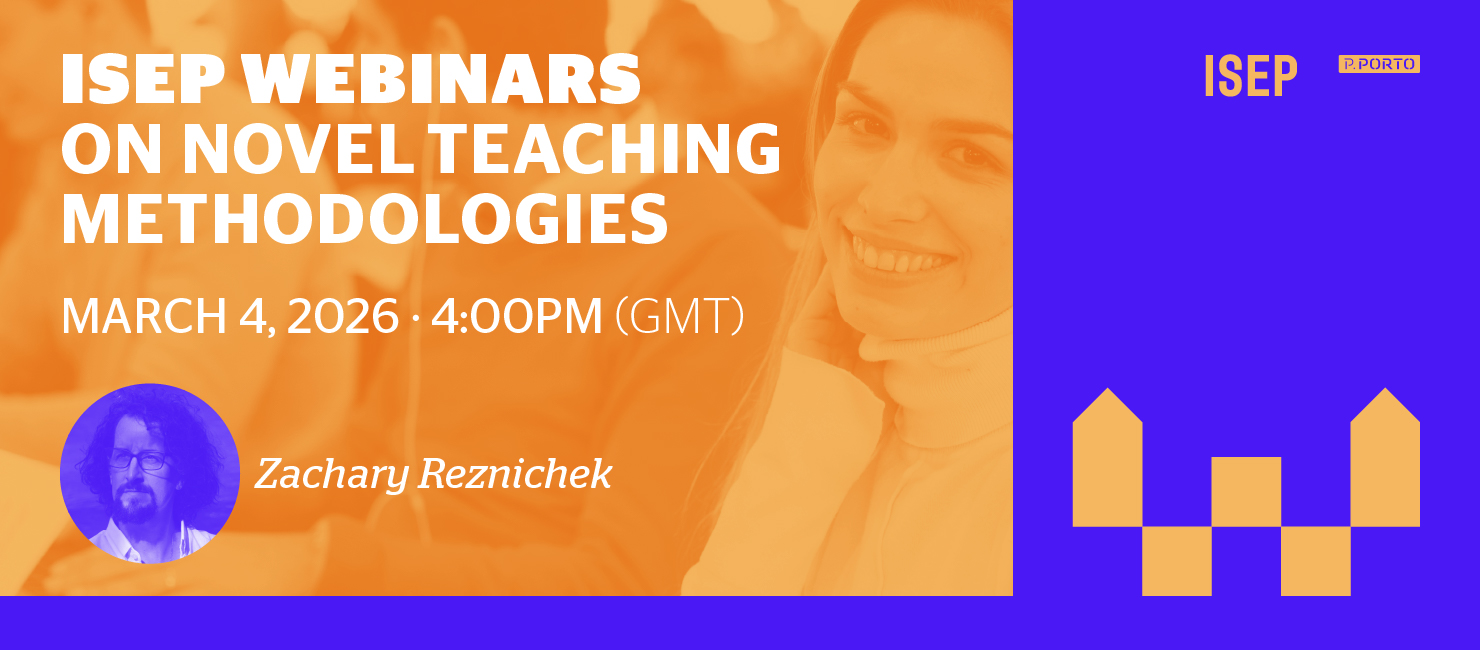
On March 4th, at 4:00 p.m., an ISEP Webinar session will take place, organized by Instituto Superior de Engenharia do Porto (ISEP).
This webinar, presented by Zachary Reznichek, is entitled “Frontloading Life-Skills”.
To access the webinar, please click here.
Abstract
Between ages 11 and 14, young people enter a distinctive developmental window marked by heightened curiosity, exploratory drive, and outward-facing engagement. In these years, learners function as little scientists testing ideas, experimenting with identity, and seeking meaningful challenges in the world around them. Before adolescence redirects attention inward through biological, social, and identity-forming pressures, educators and systems face a critical policy choice: continue narrowing this natural curiosity into performance-driven subject ladders, or intentionally frontload the life-skills and social-emotional capacities that support long-term flourishing.
Identity exploration during this period historically feared as a precursor to excessive autonomy or rebellion actually strengthens existential responsibility. When young people are supported in understanding who they are and what they value, they are less likely to pursue hedonistic or purely economic motivations and more likely to develop the internal stewardship that underpins civic and ecological responsibility. In contrast, suppressing autonomy or burdening children with premature adult expectations often fuels oppositional rebellion and disengagement.
This session positions the Teacher-Gamer methodology within established academic frameworks, including Vygotsky’s social constructivism, Dewey’s experiential learning, Bruner’s narrative identity theory, and contemporary SEL research. Through story, role-play, world-building, and collaborative quests, Teacher-Gamers create socially mediated learning environments that scaffold trust, psychological safety, perspective-taking, and self-regulation. While digital literacy remains essential, this approach emphasizes that face-to-face, embodied interaction — not solely cyber-mediated relationships — is what builds the relational depth, empathy, and communication skills required for healthy identity formation.
When we protect childhood rather than compress it, learners do not rebel away from adults they rebel with us, toward shared purpose. And when the time comes for them to take up the mantle as stewards of the planet, they do so from a grounded capacity to be stewards of themselves, something many previous generations were never taught. This abstract argues that preparing future stewards of a complex world begins with supporting young people to become confident, collaborative, and self-aware participants in their own learning journeys.
Short Bio
Zachary Reznichek is an educator, curriculum designer, and co-founder of Da Vinci Life Skills and Teacher-Gamer, where he develops systems-thinking pedagogy, mentor-training frameworks, and immersive learning models for future-ready education. Author of the 300-page Teacher-Gamer Handbook, he is a leading voice in game-based learning and intrinsic-motivation design. His research places him in the top 0.5% of authors on Academia.edu, with multiple peer-reviewed papers in the top 1% of global readership and papers translated into 5 languages. With 20 years of experience across curriculum innovation, teacher development, and interdisciplinary learning, Zachary’s work has been featured internationally through Bloomsbury, Teaching Times, Academia Letters, and keynote and chair invitations at major global conferences.