





.jpg)
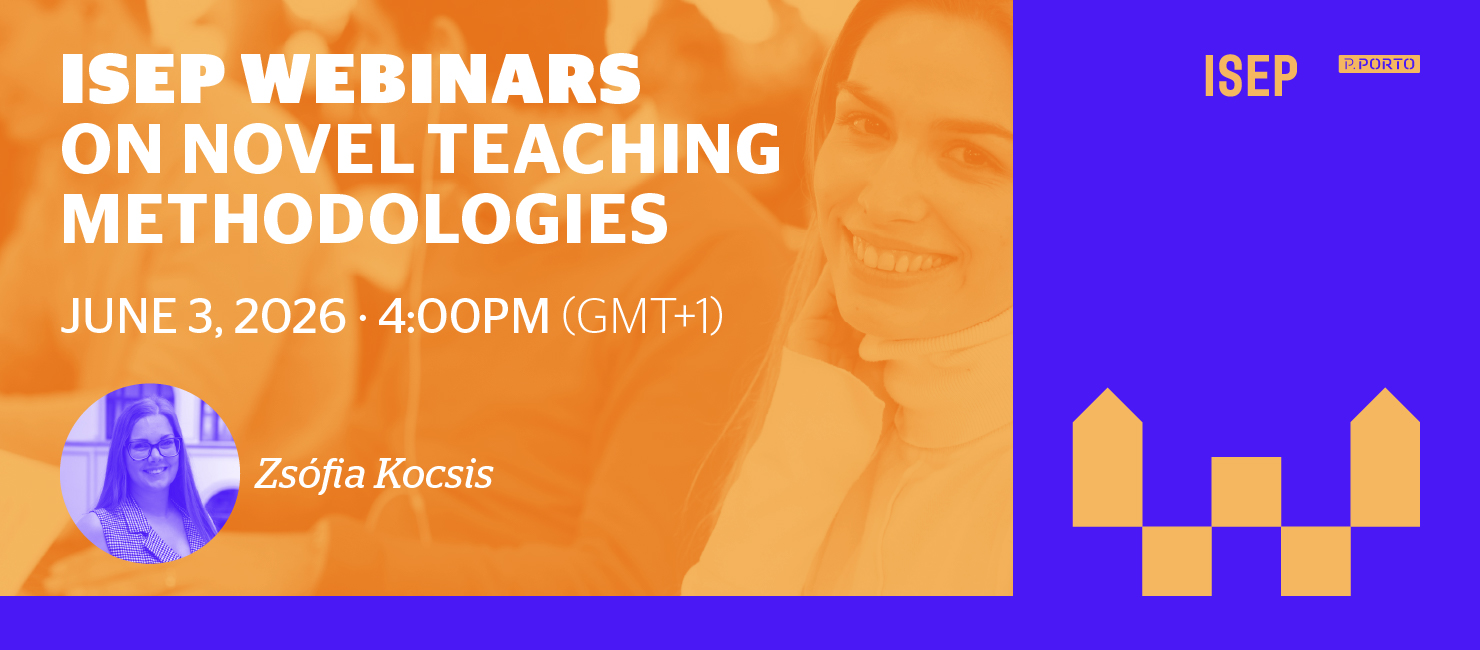
On June 3, at 4:00 p.m., a session of the ISEP Webinars will take place, organised by Instituto Superior de Engenharia do Porto (ISEP).
This webinar, presented by Zsófia Kocsis, will focus on the theme “Board games as innovative pedagogical tools in higher education”.
To access the webinar, please click here.
Abstract
Innovative teaching methodologies increasingly emphasise active learning, student engagement, and skills development. Among these approaches, the use of board games has gained attention as an effective tool to support experiential and collaborative learning in higher education. This presentation explores the pedagogical potential of board games as teaching and learning tools within university courses.
Based on practical teaching experience and research on student learning processes, the presentation introduces examples of board game applications designed to support skills development and deepen students’ understanding of specific academic topics. Special attention is given to the design and implementation of two educational board games developed for higher education contexts (K.Ö.SZ.I. and Study Hard, Work Hard!). These games aim to foster critical thinking, collaboration, problem-solving skills, and knowledge acquisition through interactive gameplay.
The session discusses how board games can contribute to more engaging and student-centred learning environments, while also addressing the challenges and opportunities of integrating playful learning methods into traditional higher education settings. Participants will gain insights into the pedagogical value of board games, practical considerations for their classroom use, and their potential role in supporting innovative teaching practices at universities.
Short bio
Zsófia Kocsis is Assistant Professor at the Institute of Educational and Cultural Studies, Faculty of Humanities, University of Debrecen, Hungary. Her research focuses on student employment and the relationship between work and academic performance. In recent years, she has also expanded her research and teaching activities to include the use of board games in higher education. She has led the development of two educational board games (K.Ö.SZ.I. and Study Hard, Work Hard!), which aim to develop students’ skills and broaden their knowledge in the field.